ABOVE;DR: Large Excel imports in Angular Spreadsheet freeze the UI because synchronous XLSX parsing (styles, formats, objects) blocks the main thread. Optimize imports by disabling style/format parsing, applying cell and file size thresholds on the server side, and using openFromJson with selective deserialization for predictable performance and lower memory usage.
Have you ever uploaded an Excel file and noticed your web application immediately freezes? This happens more often when users try to import Excel files in Angular. Large workbooks can easily slow down the browser, trigger memory spikes, or freeze while reading files, making the entire page feel unresponsive.
Most Angular applications freeze during large Excel imports because the browser tries to parse every cell, style, formula, and object on the main thread. This causes long pauses, high memory usage, and unpredictable “page unresponsive” errors.
Synchronization® Angular Spreadsheet Editor avoids this problem by loading only what is needed, enforcing file size and data limits, and allowing large workbooks to be opened quickly through lightweight JSON loading rather than full XLSX parsing.
In this blog, you will learn three specific techniques to fix this:
Let’s dive deeper into the techniques that make large Excel imports fast and reliable.
Why large Excel imports silently break web applications
Large Excel files don’t just “take longer.” This often sets off a chain reaction that feels like a crash:
- The page freezes because parsing blocks the UI thread.
- Memory surges because of the workbook’s style, format, images, and metadata.
- Import time expired on slower machines or remote environments.
- Users don’t get actionable errorsjust the screen freezes or the tab goes dead.
This is very common in enterprise scenarios where a “normal” spreadsheet contains hundreds of thousands of cells plus formatting rules, validations, and embedded objects.
How Syncfusion Angular Spreadsheet eliminates large file import failures
Many applications fail because they load everything at once. Syncfusion Angular Spreadsheet Editor is designed to avoid that pattern by letting you:
- Load only what you need (data vs. styles/features)
- Apply a threshold before files flood the system
- Open workbooks from lightweight JSON to get started faster
Curious to see Angular Spreadsheet in action? Explore the live demo.
Parsing options: Load only what you need
Most Excel imports fail not because of the volume of data alone, but because formatting overhead. Styles, number formats, and blank cell metadata significantly increase parsing costs, even when your application only requires raw values.
Syncfusion solves this problem with WorkbookParseOptions. By enabling the IgnoreStyle and IgnoreFormat properties on the server, the spreadsheet loads only the raw data, thereby ignoring all formatting overhead.
Here is a server side example:
public IActionResult Open(IFormCollection openRequest)
{
    OpenRequest open = new OpenRequest();
    ...
    // Enable parsing options to skip styles and formats for faster loading
    open.ParseOptions = new WorkbookParseOptions()
    {
        IgnoreStyle = true,
        IgnoreFormat = true
    };
    ...
    // Process and return the parsed workbook data
    return Content(Workbook.Open(open));
}
By disabling style and format parsing:
- Only raw cell values are processed
- JSON payload size is reduced
- Memory usage drops significantly
- Import times soon improved
Notes: This option is ideal when number styles and formats are not important for your use case, and the goal is to load Excel data as quickly as possible.
What you get
- Faster file loading
- Lower memory usage
- A smaller JSON payload is sent to the client
This is ideal for importing “data pipelines” where the format is not relevant (financial exports, HR records, inventory loads).
Threshold limit: Stop a file before it crashes the app
Large Excel files don’t just burden the browser; they can also increase server memory. Without security checks, a single large upload can silently degrade the performance of your entire application.
Syncfusion threshold limits give you a clear control point. You can define:
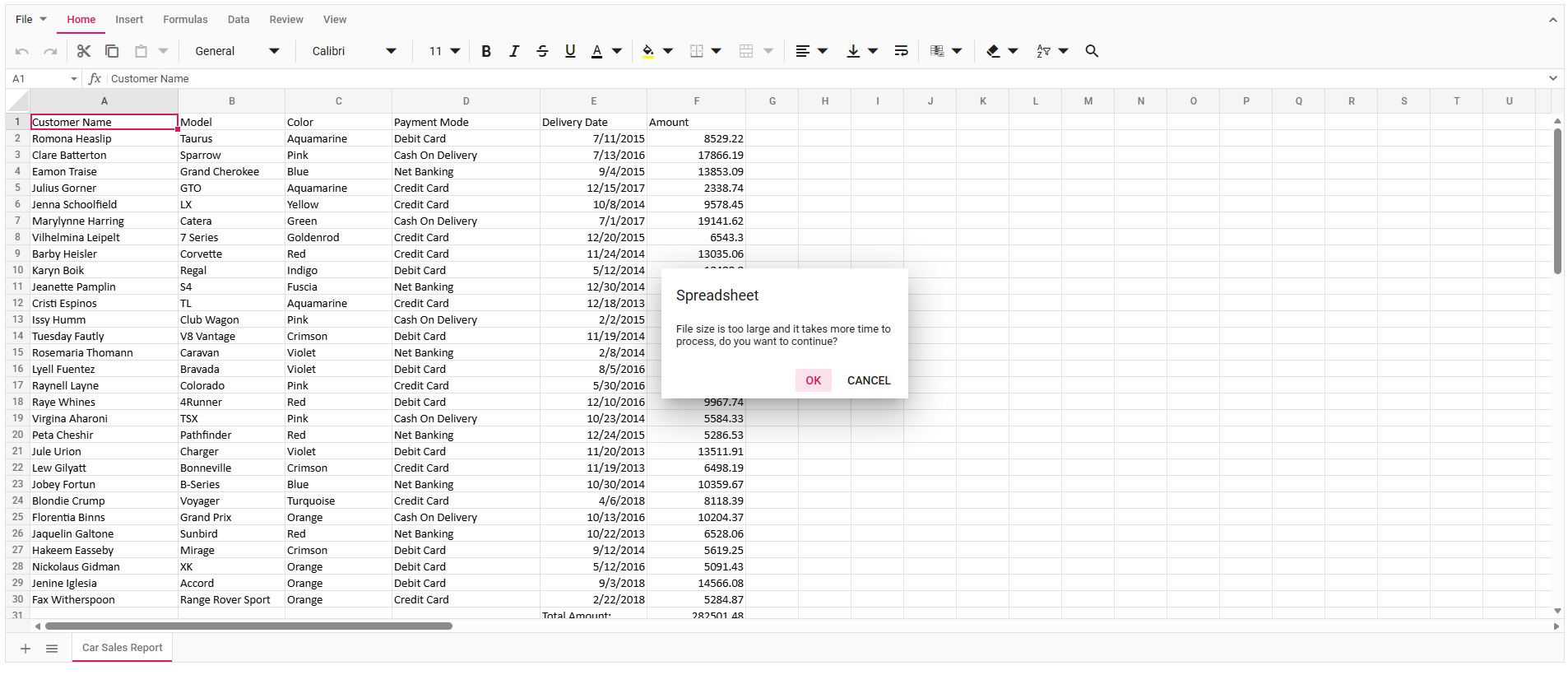
What happens if the limit is exceeded
- A warning message appears:
The file is large. Cancelstop imports cleanlyOKcontinues (only if your application logic allows it)
This single check prevents crashes, timeouts, and memory overflows caused by unexpectedly large uploads, and provides users with clarity, not confusion.
You can configure the threshold API on the server side using the following code example:
public IActionResult Open(IFormCollection openRequest)
{
    OpenRequest open = new OpenRequest();
    open.File = openRequest.Files[0];
    open.Guid = openRequest["Guid"];

    // Set maximum allowed number of cells
    open.ThresholdLimit.MaximumDataLimit = 1000000; // 1,000,000 cells

    // Set maximum allowed file size in bytes (e.g., 5MB)
    open.ThresholdLimit.MaximumFileSize = 5000000;

    var openbook = Content(Workbook.Open(open));
    return openbook;
}
The code example above implements a security gate before parsing becomes expensive, thereby protecting the user experience and backend stability.
JSON serialization: Parse once, open immediately
Full parsing XLSX files on each file opened is expensive. If a workbook includes charts, images, conditional formatting, or complex styles, that overhead adds up quickly.
Syncfusion Angular Spreadsheet solves this problem with JSON serialization options. This lets you exclude certain features, such as styles, formats, charts, images, wrappers, and others, from a Workbook JSON object when opening it via the openFromJson method.
Why JSON based loading is faster
Use openFromJsonYou can:
- Avoid repeated XLSX parsing
- Exclude features your app doesn’t need
- Reduce JSON size and processing time
- Improve loading speed for large or complex workbooks
Syncfusion also supports selective deserialization. You can choose which parts of JSON to ignore during loading. Previously, openFromJson always contains every element: styles, formulas, conditional formatting, charts, images, validations, and Notes. Now you control it explicitly.
Client side example:
// Load workbook JSON — ignore styles for faster rendering of the spreadsheet
.openFromJson(
    { file: fileJson },
    { ignoreStyle: true }
);
This gives you complete control over the loading process, exactly what you need when importing large Excel files in Angular applications with complex structures.
Want to know more details about these techniques? Explore the complete Angular Spreadsheet documentation.
Configuring Syncfusion Angular Spreadsheet for large file import
Here’s how to integrate Syncfusion Spreadsheet into your Angular application from scratch.
Step 1: Install Angular CLI
You can use the Angular CLI to set up your Angular application. To install Angular CLI, use the following command:
npm install -g @angular/cliStep 2: Create a new Angular application
You can create a new Angular application using the following Angular CLI commands:
Select your preferred stylesheet format (CSS/SCSS) And SSR options when prompted.
Step 3: Install the Syncfusion Spreadsheet package
For Angle 12 and above (Ivy distribution):
Install the @syncfusion/ej2-angular-spreadsheet package in the app.
//  Navigate into your project
cd my-app
npm install @syncfusion/ej2-angular-spreadsheet
For Angular versions below 12 (ngcc build):
Install the @syncfusion/ej2-angular-spreadsheet@ngcc package in the app.
npm install @syncfusion/ej2-angular-spreadsheet@ngccIf using ngccThat package.json the entry looks like:
@syncfusion/ej2-angular-spreadsheet:"20.2.38-ngcc"Step 4: Add necessary CSS references
Next, add the necessary CSS references src/styles.css.
@import '../node_modules/@syncfusion/ej2-base/styles/material.css';
@import '../node_modules/@syncfusion/ej2-inputs/styles/material.css';
@import '../node_modules/@syncfusion/ej2-buttons/styles/material.css';
@import '../node_modules/@syncfusion/ej2-splitbuttons/styles/material.css';
@import '../node_modules/@syncfusion/ej2-lists/styles/material.css';
@import '../node_modules/@syncfusion/ej2-navigations/styles/material.css';
@import '../node_modules/@syncfusion/ej2-popups/styles/material.css';
@import '../node_modules/@syncfusion/ej2-dropdowns/styles/material.css';
@import '../node_modules/@syncfusion/ej2-spreadsheet/styles/material.css';
@import '../node_modules/@syncfusion/ej2-grids/styles/material.css';
Step 5: Add the Spreadsheet component
Update your component file to import the module and render the spreadsheet.
import { NgModule } from '@angular/core'
import { BrowserModule } from '@angular/platform-browser'
import { SpreadsheetAllModule } from '@syncfusion/ej2-angular-spreadsheet'
import { Component, OnInit, ViewChild } from '@angular/core';
import { SpreadsheetComponent } from '@syncfusion/ej2-angular-spreadsheet';
import { data } from './datasource';

@Component({
    imports: [SpreadsheetAllModule],
    standalone: true,
    selector: 'app-container',
    template: "
        <ejs-spreadsheet #spreadsheet>
            <e-sheets>
                <e-sheet>
                    <e-ranges>
                        <e-range [dataSource]='data'></e-range>
                    </e-ranges>
                    <e-columns>
                        <e-column [width]=90></e-column>
                        <e-column [width]=100></e-column>
                        <e-column [width]=96></e-column>
                        <e-column [width]=120></e-column>
                        <e-column [width]=130></e-column>
                        <e-column [width]=120></e-column>
                    </e-columns>
                </e-sheet>
            </e-sheets>
        </ejs-spreadsheet>
    "
})
export class AppComponent implements OnInit {
    public data?: object[];
    @ViewChild('spreadsheet')
    public spreadsheetObj?: SpreadsheetComponent;
    // Load data from your local datasource on component initialization
    ngOnInit(): void {
        this.data = data;
    }
};
Step 6: Run the application
Start your application using:
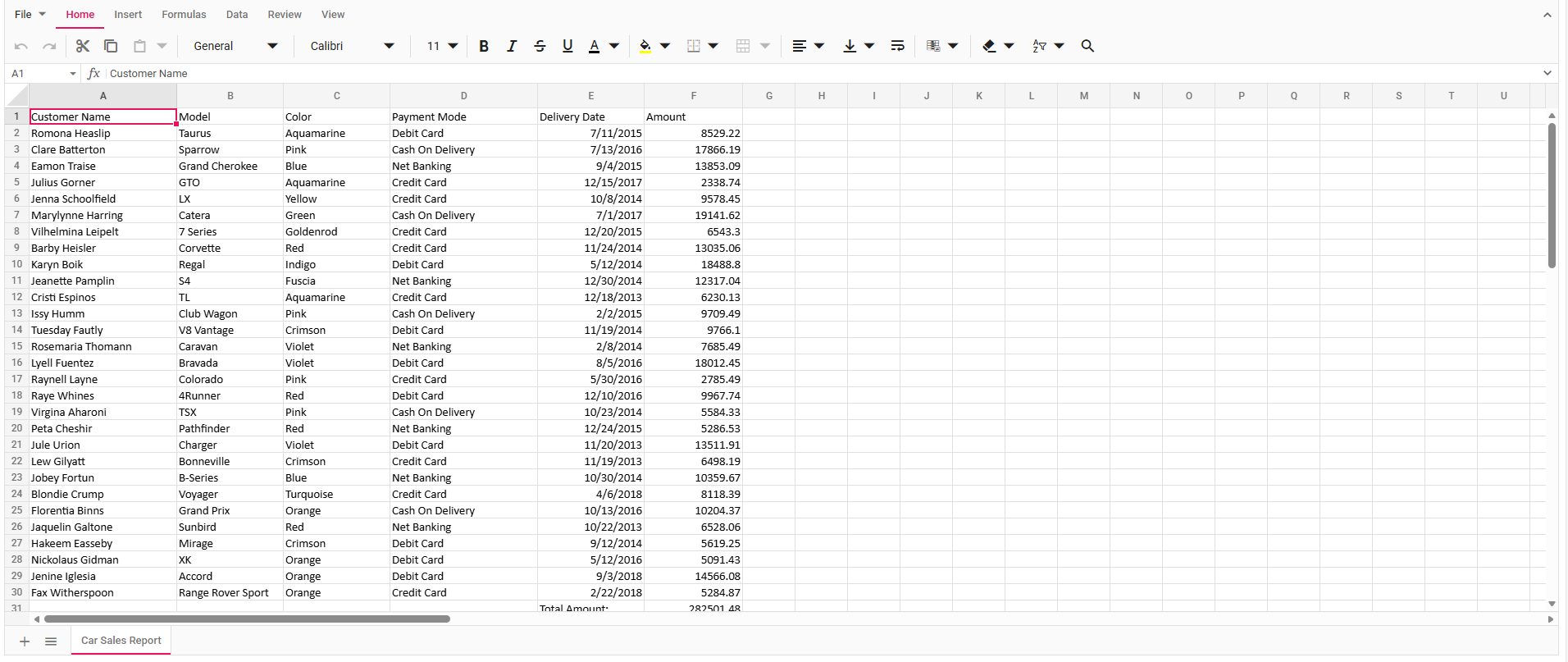
Here’s the spreadsheet display:
Want more info on setting up an Angular Spreadsheet? View complete setup details.
Performance metrics: Import 500K cells in less than 5 seconds
Most web-based spreadsheet editors struggle to load even 100,000 cells without freezing the browser. Syncfusion Angular Spreadsheet Editor processes half a million cells with validation 4.16 seconds and keep the UI fully responsive.
| Data Set Description | Time Import |
| 100,000 cells with formatting | 3.85 seconds |
| 250,000 cells with formatting | 3.96 seconds |
| 100,000 cells with validation | 2.06p |
| 250,000 cells with validation | 3.77 seconds |
| 500,000 cells with validation | 4.16 seconds |
| 100,000 cells with sorting/filtering | 3.68 seconds |
| 250,000 cells with sorting/filtering | 5.73 seconds |
| 500,000 cells with sorting/filtering | 8.59 seconds |
As the size of the data set increases 100K → 250K → 500K cell, import time scale almost linear without exponential slowdowns, memory glitches, or sudden crashes. That’s the performance baseline you need to confidently ship enterprise-grade Angular applications.
Wondering how fast Syncfusion actually is? Explore more Spreadsheet Performance Metrics in our documentation.
Frequently Asked Questions
Can I restrict users from uploading large Excel files?
Yes. Set MaximumDataLimit and MaximumFileSize on the server. If files exceed any limits, Sheets will display a warning, so users can cancel rather than crash the app.
Does ignoring styles change the original Excel file?
No. This option only affects how files are loaded into the Angular application.
Which Excel formats are supported for import?
Excel (.xlsx, .xls) and CSV files are supported, along with JSON and remote data sources.
Can this optimization be used with virtual scrolling?
Yes. Combining parse optimization with row and column virtualization further improves performance.
What versions of Angular are supported?
Angular 12 and above uses the Ivy distribution, with ngcc builds available for older versions.

Try Now for Free
Conclusion
Thanks for reading! Large Excel imports don’t fail because Angular is slow, they fail because the browser is asked to do too much work at once. Syncfusion’s Angular Spreadsheet Editor provides a production-ready solution with three focused techniques:
- Selective parsing to skip unnecessary formatting
- Threshold for blocking malicious uploads
- JSON-based loading to avoid repeated XLSX processing
You can build Angular applications that handle large Excel files reliably, predictably, and at enterprise scale.
Ready to Handle Large Excel Files Without Crashes or Timeouts? Explore Syncfusion’s Angular Spreadsheet Editor. If you are a Syncfusion user, you can download the setup from the license and downloads page. Otherwise, you can download a free 30-day trial.
You can also contact us via the support forum, support portal, or feedback portal for questions. We are always happy to help you!
PakarPBN
A Private Blog Network (PBN) is a collection of websites that are controlled by a single individual or organization and used primarily to build backlinks to a “money site” in order to influence its ranking in search engines such as Google. The core idea behind a PBN is based on the importance of backlinks in Google’s ranking algorithm. Since Google views backlinks as signals of authority and trust, some website owners attempt to artificially create these signals through a controlled network of sites.
In a typical PBN setup, the owner acquires expired or aged domains that already have existing authority, backlinks, and history. These domains are rebuilt with new content and hosted separately, often using different IP addresses, hosting providers, themes, and ownership details to make them appear unrelated. Within the content published on these sites, links are strategically placed that point to the main website the owner wants to rank higher. By doing this, the owner attempts to pass link equity (also known as “link juice”) from the PBN sites to the target website.
The purpose of a PBN is to give the impression that the target website is naturally earning links from multiple independent sources. If done effectively, this can temporarily improve keyword rankings, increase organic visibility, and drive more traffic from search results.
Comments are closed, but trackbacks and pingbacks are open.