ABOVE;DR: CSV exports slow down modern web applications with versioning issues, outdated data, and broken validation. In-browser spreadsheets offer a more efficient approach by enabling structured, real-time editing directly within the application, improving data consistency, user experience, and workflow efficiency across dashboards, operations, and internal tools.
If your app still relies on “Export to CSV” for quick edits, you’ve probably seen this happen:
Someone downloads a file, opens it in Excel or Google Sheets, makes a few updates… and then things start to get messy.
- Which version is the latest?
- Why did the upload fail?
- Who changed this value?
At first, it feels like a simple workflow. But once the team relies on him every day, the cracks start to show.
A modern alternative is an in-browser spreadsheet: an Excel-like editor embedded directly in your web application. Users edit data on the spot with familiar spreadsheet interactions without leaving the product.
In this article, we will look at how to embed spreadsheet in browser in React using Syncfusion® React Spreadsheet Editor.
Hidden problem with CSV export
CSV export is not designed for continuous in-app data editing. This is a useful solution at a time when web applications cannot handle complex grids.
Currently, these solutions are creating more problems than they solve.
Here’s what usually goes wrong:
- Version confusion: Lots of files floating around, no clear “source of truth.”
- Stale data: As files are exported, they start to move away from the live data.
- Broken structure: No formulas, no formatting, no validation, just raw values.
- Additional technical costs: Imports fail, formats don’t match, edge cases pile up.
Individually, these are minor issues. Together, they slow down team work and create unnecessary risks.
When exports stop, productivity also decreases
What seems like a simple export, edit, and upload loop secretly adds friction at every step.
Now imagine the finance team updating quarterly forecasts.
They exported the CSV, changed some numbers, and re-uploaded it. But the formula is gone, the number format is inconsistent, and the validation rules no longer exist.
Someone found an error. Another file is downloaded. Another version was created.
By the time the data is “final”, no one completely trusts it.
This isn’t an equipment issue; it’s a workflow issue.
So what changed?
Instead of pushing users to Excel, many modern web applications do the opposite:
They bring spreadsheet-like editing right into the application.
It means:
- Edit the data in place
- Keep everything connected with live data
- Implement validation before errors occur
- Maintain a single source of truth
No export. No upload. No need to guess.
CSV vs. CSV Export Spreadsheets in browsers: What’s really changed
Here are the real differences, not in the features, but in the experience:
| CSV Workflow | Spreadsheet In Browser |
| Download → Edit → Upload | Edit directly within the app. |
| Static data snippet | Always work with live data. |
| No built-in validation | Controlled, rule-based editing |
| Multiple file versions | One common source of truth. |
| Error-prone updates | Guided and structured change |
This shift is not just technical; it’s about removing unnecessary steps.
When CSV still made sense
CSV exports still have their place.
They are useful when:
- Data needs to be shared externally
- Offline access is required
- This task involves a one-time export
The problem arises when CSV becomes the default for everyday editing.
What makes Sheets in the browser ready for enterprise use?
Embedding a spreadsheet into a production application requires more than just rendering a grid.
Key considerations include:
- Show: Large data sets require efficient rendering (virtualization) and careful recalculation strategies.
- Scalability: Determine how edits are synced to your backend (save on change vs save on submit, conflict handling).
- Maintenance: Prefer components with stable APIs and documented configuration patterns.
- Security/permissions: Restrict editing by role, protect sheets/ranges, and validate input at the cell level.
- Accessibility: Keyboard navigation and screen reader support are important for enterprise launches.
Modern approach: In-browser Spreadsheet Editor
Embedded spreadsheet components bring spreadsheet-style editing directly to your web applications, without forcing users to switch tools.
Instead of exporting files and reimporting them later, users can work with data in a structured, interactive grid that stays connected to your application.
This approach lets your app keep control of:
- Data access and permissions
- Validation and business rules
- Real-time updates and consistency
Today, many teams use off-the-shelf spreadsheet components to support this pattern, rather than building everything from scratch.
For example, in a React application, a component such as Syncfusion React Spreadsheet Editor can provide the core functionality needed to support in-application editing, including handling large data sets, applying validation, and maintaining a consistent data structure.
Embedding a Spreadsheet In a Browser in a React app
Rather than relying on exports, you can bring spreadsheet-style editing directly into your React application with ready-to-use components.
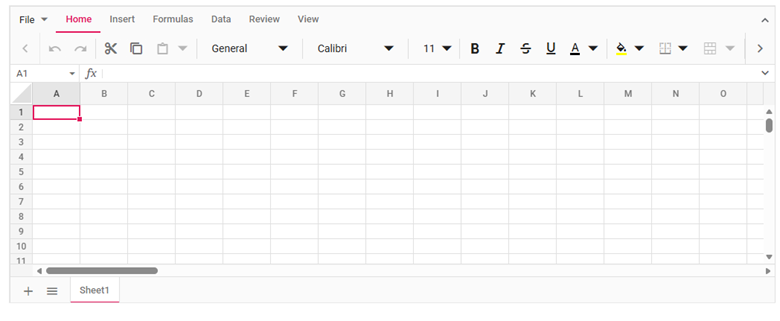
At a high level, integration is easy. Once a spreadsheet component is added to your project, it can render an interactive grid in your application, so users can immediately start editing data. From a user’s perspective, this feels very similar to working in Excel or Google Sheets, but without leaving the application.
In a typical setup, you import a spreadsheet component into a React application and render it like any other UI element:
import * as React from 'react';
import { SpreadsheetComponent } from '@syncfusion/ej2-react-spreadsheet';
import './App.css';
export default function App() {
    return  (<SpreadsheetComponent/>);
}
From there, you can add additional capabilities based on your use case, whether it’s loading data, applying validation rules, or enabling formatting and formulas.
Rather than building complex grid logic from scratch, this approach lets you focus on how users interact with the data in your product, while spreadsheet components handle the heavy lifting behind the scenes.
If you want to dive deeper into advanced configurations and capabilities, the official documentation covers everything from data binding to feature customization.
Real world scenarios that make a difference
This approach becomes especially valuable in workflows where data changes frequently:
- Internal dashboard and admin tools: Teams can update operational data directly, without switching tools or managing multiple file versions.
- Finance and operations: Maintaining structured data helps reduce errors in calculations and reporting.
- HR and big data sets: Managing large amounts of structured data becomes more powerful and easy to navigate.
- Sales and pricing tools: Teams can quickly test scenarios and update values without interrupting their workflow.
- Data entry portal: Built-in validation ensures data is cleaner and more consistent from the start.
This is not an extreme case; they reflect how many teams are already working today.
Frequently Asked Questions
Will in-browser spreadsheets work with existing Excel files?
Yes. You can open and export Excel (XLSX) and CSV files directly in the browser. Most formatting, formulas, and structure are preserved, so you don’t lose context when working with existing files.
Can an in-browser spreadsheet edit a CSV file directly?
Yes. CSV files can be opened, edited, and validated in a spreadsheet interface, then exported again if needed.
What features does an in-browser spreadsheet provide?
Can an in-browser spreadsheet control what users are allowed to edit?
Does the in-browser spreadsheet support accessibility and localization?
Yes. It includes keyboard navigation, screen reader support (WAI-ARIA), RTL layout, and date and format localization, making it suitable for global applications.
Final thoughts
Many web applications still rely on CSV exports because “it’s always been done.”
But in reality, teams are quietly moving away from this, especially in products where data changes frequently.
If your users export files every day just to make edits, it’s worth asking: Is the process helping or slowing them down?
Because sometimes, the biggest improvement isn’t a new feature, but rather the removal of an unnecessary step.
For React teams, our React Spreadsheet Editor provides a practical path to delivering an Excel-like experience with import/export and performance features. If your users edit data every day, it’s worth evaluating an embedded spreadsheet approach and testing it against your current CSV workflow.
Still relying on CSV files for your daily workflow? Switch to a spreadsheet in a modern browser and see the difference for yourself with a live demo.
If you are a Syncfusion user, you can download the setup from the license and downloads page. Otherwise, you can download a free 30-day trial.
You can also contact us via the support forum, support portal, or feedback portal for questions. We are always happy to help you!
PakarPBN
A Private Blog Network (PBN) is a collection of websites that are controlled by a single individual or organization and used primarily to build backlinks to a “money site” in order to influence its ranking in search engines such as Google. The core idea behind a PBN is based on the importance of backlinks in Google’s ranking algorithm. Since Google views backlinks as signals of authority and trust, some website owners attempt to artificially create these signals through a controlled network of sites.
In a typical PBN setup, the owner acquires expired or aged domains that already have existing authority, backlinks, and history. These domains are rebuilt with new content and hosted separately, often using different IP addresses, hosting providers, themes, and ownership details to make them appear unrelated. Within the content published on these sites, links are strategically placed that point to the main website the owner wants to rank higher. By doing this, the owner attempts to pass link equity (also known as “link juice”) from the PBN sites to the target website.
The purpose of a PBN is to give the impression that the target website is naturally earning links from multiple independent sources. If done effectively, this can temporarily improve keyword rankings, increase organic visibility, and drive more traffic from search results.
Comments are closed, but trackbacks and pingbacks are open.